
Episode 22 · 16 November 2026
Moverot: wellness benefits that actually get used
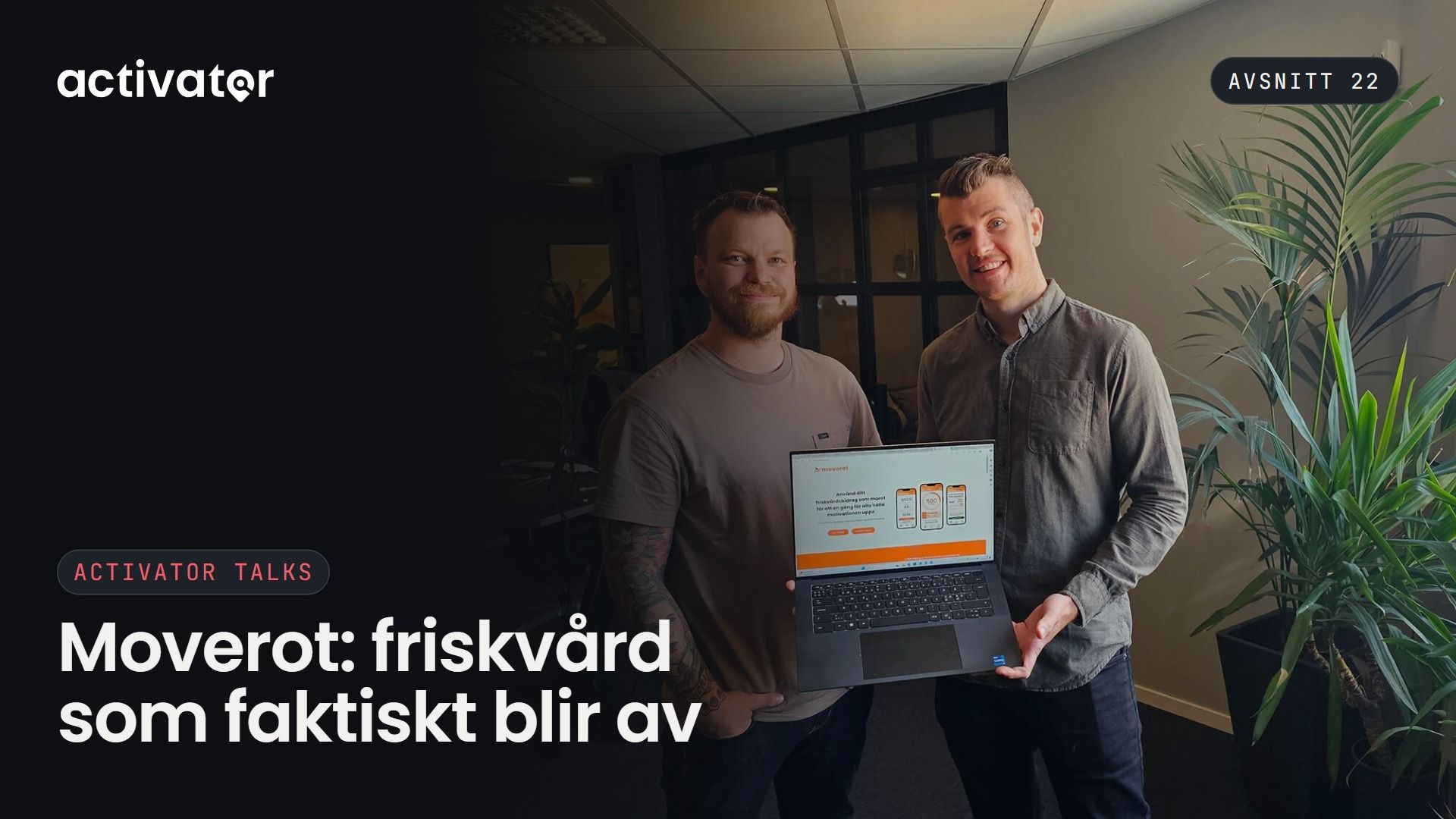
The wellness allowance is a popular employee benefit, but does it actually lead to any exercise? Robert Asklund, CEO of Moverot, explains how they turned the model around so that employers only pay for exercise that actually happens. Activator built the app and now runs and develops it further with AI agents.
About the episode
Many employers pay out a wellness allowance and hope their staff will exercise. In this episode of Activator Talks, Robert Asklund, CEO of the health-tech company Moverot, explains why they wanted to turn that around. Johan Åhlund and Robert Jansz ask him how the app works and what employers think of it.
Questions this episode answers
- Why is the wellness allowance not enough?
- How does Moverot work for the person exercising?
- Can the wellness allowance be used for Moverot?
- How does a company get started?
From idea to production
Activator built Moverot from idea to an app in the App Store and on Google Play. We still handle operations, support and further development. Today AI agents do much of the maintenance, while a person reviews every release before it ships. That is how we work with every client: we find where AI makes the biggest difference, build it and teach the team to own it.
For employers and HR managers who want more of their staff to get moving. And for anyone with an idea for an app of their own. The conversation is in Swedish.
Read the conversation
The conversation is in Swedish. The text was made with speech recognition and may contain errors.
Hi and welcome to Activator Talks. My name is Robert Jansz and I run Activator, an AI agency. Here I talk with business owners and experts about how AI and smart technology make everyday life easier for companies. I'm Johan Åhlund. Hello, hello. And Robert Asklund. Hey there. We thought we'd do a quick round of introductions, who we are and what we work with. To start with, so that you who are listening get to know us. We can start with you, Johan Åhlund. I work with communications and marketing and I'm based at River Street Lab. I work as CEO of Moverot, a health-tech company where we help employees exercise. So I do a bit of everything. Interesting. So, Robert Asklund, most companies already give their employees a wellness allowance. What's your thing here, and why isn't that enough? Exactly, the reason we started was that, sure, the wellness allowance is a great benefit, but it's very uncertain. It's not a well-targeted investment for a company.
Because as an employer, you give the wellness allowance to your employees and then you hope they'll exercise. So you pay money and hope for exercise. That's where we wanted to change things a bit, because I've talked to a lot of employers and that's where the problem lies. They want to be able to get involved, have an influence and get more reliable exercise. So we turned the question around and said: we create the exercise, and then you pay based on the exercise we've created. That way it becomes a safe investment for you as an employer. You know what you're getting and you always get statistics on what you're paying for. So we don't waste a lot of money on exercise that never happens. And the reason we're so confident in this business model is that we've really focused on getting people to exercise, on keeping the thresholds low, on making it easy for everyone to get started and exercise in a good way. This sounds really interesting, because it both promotes public health and increases everyday exercise, but how does it work for an employee who has been given Moverot through work?
That's a good question, it's the core question we've had: it should be simple and everyone should understand what it is, because it's still an app, so some people may find it a bit technical, but we've chosen to keep it simple so everyone can understand it and manage it. It's quite simply this: you have a goal to reach. You have an app, you get access to the app, the Moverot service, and then you get a goal to reach. The goal is to collect carrot coins to reach your carrot. You exercise your way to a gift card, so you're always working out toward something you want. That sounds great for the individual and for the company, and you get healthy employees. Yes, it feels like a win-win. It's really important in today's society, which is more sedentary than ever. But to me, that sounds a bit like a pedometer where you then get a gift card back that you can go shopping with.
What do employers say about that? Well, it's great, because actually you're pretty much right, although it's a somewhat more advanced pedometer, I'd say. Based on the Public Health Agency of Sweden's recommendations for physical activity, we've created a workout, or a motivation session as we call it, for you to complete. Employers are really happy, because we create exercise that in many cases wouldn't have happened otherwise. By giving this reward, the carrot, people always have a motivation to get going. What we see as important here is getting people moving who don't usually move in their everyday lives, to strengthen the whole company from the ground up and build a good, stable, healthy foundation in the business, instead of just benefiting a few who like going to the gym? You're onto something really important there, because you're talking about being healthy specifically, and we talked earlier about how this isn't some kind of military training or cracking the whip. Instead you focus on ordinary people who, on their own terms, entirely on their own terms, can get everyday exercise, for example to and from work, and then be rewarded for it when they go for a walk with the stroller, cycle to work or simply walk. Yes, exactly, and as we usually say: the most important workout is the one that actually happens.
So it doesn't matter if you have a gym membership. If you don't use it, it doesn't achieve anything. So we aim for exercise that everyone can manage on their own terms. It sounds great to have healthy staff who move. Yes, the health benefits of that are enormous. Yes, but there's been a lot of discussion over the years. What are you allowed to use your wellness allowance for? Some people buy gym memberships. Personally, I've used it for lift passes when I go snowboarding. To be able to exercise. Previously some sports like that were excluded. You weren't allowed to use it for them. But the Swedish Tax Agency (Skatteverket) has relaxed a lot of these rules. Today you can use the wellness allowance for many different sports and activities. What do you say about Moverot and the wellness allowance? Is it okay to use according to Skatteverket? Yes, it's okay to use for wellness. It's digital training, and they write quite a lot about that.
That's one of the things that has become popular lately and been approved by Skatteverket, digital training specifically, something that promotes exercise or health. So yes, absolutely, and to a large extent we started Moverot to make the wellness allowance more reliable. There are lots of statistics showing that many wellness allowances are wasted or go unused, so we wanted to create an alternative that people want, one that gets people going and actually exercising, instead of just wasting the money. That sounds great. You hear figures saying that many millions of kronor in wellness allowances simply go unused. Do you have a figure for how much money Swedish employees are entitled to in wellness allowances and how much of it is used each year? Yes, those are interesting figures. We've found figures saying that up to SEK 2 billion in wellness allowances goes to waste every year. But if we look at the individual level, Skatteverket says a maximum of SEK 5,000.
Then it varies a lot from workplace to workplace. But we see that the average is about SEK 2,500, though it's starting to rise a bit. But yes, we still see that the most important thing is that you exercise, not that you spend the money. No, it's important that you get something worthwhile out of it in the end. For many companies this seems to be a very social thing, that you strengthen the team, you go out together instead of sitting indoors at lunch or whatever, and that it's then noticed and appreciated by management, which lowers the threshold for getting out and exercising, and then you get a reward once you reach the goal. Are there different stages and steps, or how does the setup actually work when you head out? You start the app, see the map, or rather the interface, and you start walking and see your progress there. How does that work? Well, technically, you see your goal in the app, how far you have to go, how many carrot coins you need to collect, how far you have left and how many you've collected.
And then every time you start a workout, it's very simple, you just tap start a walk if you're going for a walk, a run if you're going running, or a bike ride. And then you just start moving. Put the phone in your pocket and focus on your nice walk. When you're done you just tap finish and you get your reward based on your performance. And it's tiered, so the further you get on the journey, the bigger the rewards and the more fun it is to exercise. It's all about building a habit, making it fun to take the next walk or run because you see that this time you got a much bigger reward than last time. That way you're always chasing that carrot. That sounds interesting, because it's individually tailored too. If the rain is pouring down or you end up in a snowstorm, does Moverot work on the treadmill at home too? Yes, it does. That's a really nice feature, we can connect to the pedometer in the phone.
Oh, how clever. So you just put the phone in your pocket, hop on the treadmill and go. Yes, no more excuses. No, we try to minimize those. Remove every threshold we find. That sounds super simple and convenient. But what if you want to get started? Say I work at a company and I'd like to get my employer to buy Moverot so all the staff can use it. How do you go about it? Yes, exactly. Just get in touch with me. If you're a private individual and want to use it yourself, the wellness allowance is a good option. You'll find us on Epassi and several other wellness portals. Otherwise I'd warmly recommend that you don't pay for it yourself, but that you as an employer get everyone exercising collectively. In that case it's better to contact me, and we simply kick off a joint workout for all employees, and we've set it up so cleverly that we only charge for exercise that actually happens.
Like you mentioned just now, Johan, exercising collectively. We give the app to all employees. You get to exercise together. You can also exercise individually in your spare time. You get a goal that all of you need to reach together, and you pay nothing. It's the employer who covers the whole cost, but the cost only applies to the exercise that has actually been done. So it's a clear-cut quality investment. We offer a 100% exercise guarantee. That sounds fantastic. I'm going to talk to the company about it right away. Thanks for listening to Activator Talks. Follow the podcast wherever you listen to podcasts, like Spotify, Apple Podcasts and YouTube. That way you won't miss an episode. All episodes are also available at activator.se. If you want to know how AI can help your company, you're welcome to get in touch. Talk to you in the next episode.