
Episode 24 · 16 November 2026
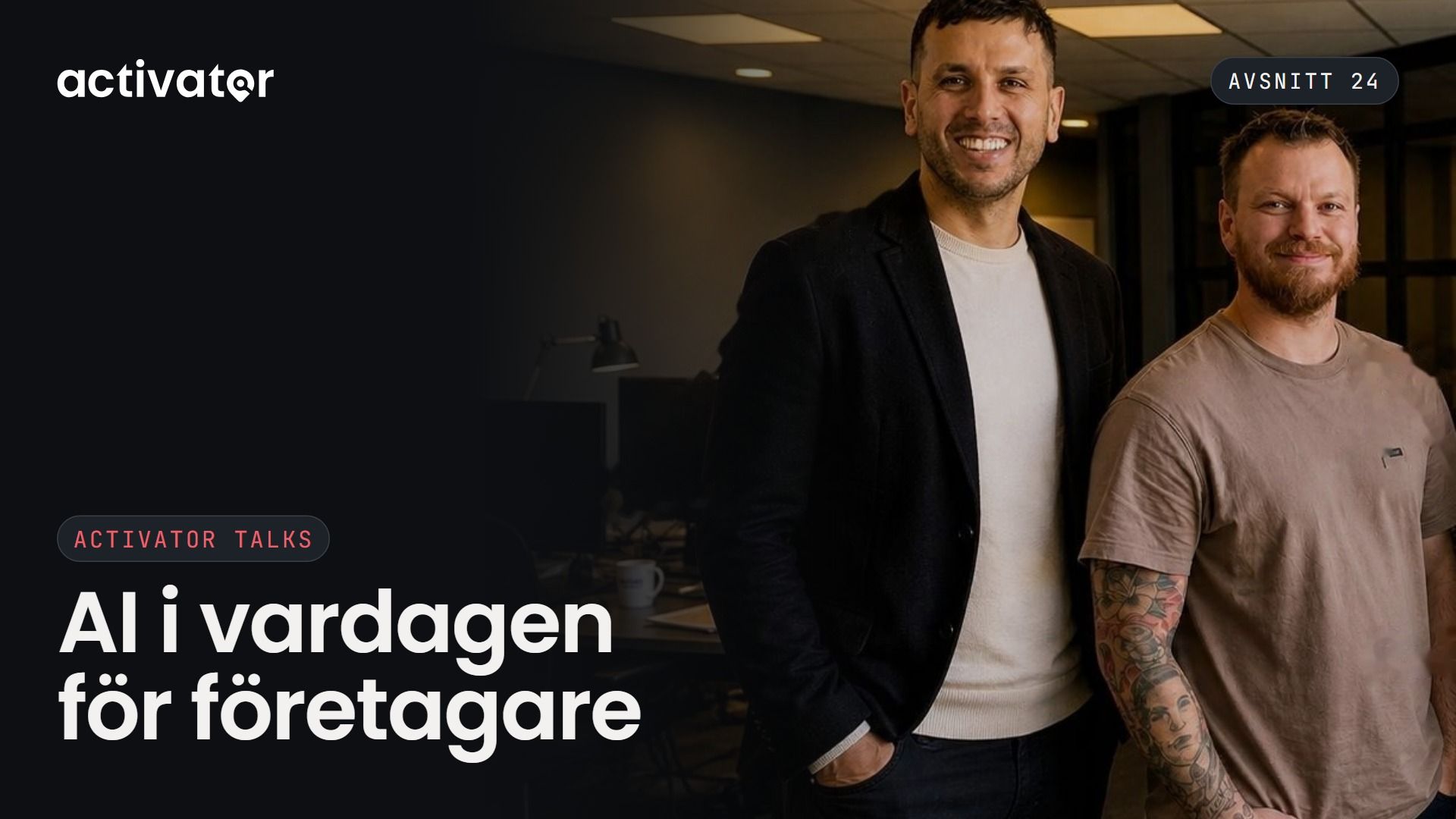
Everyday AI for business owners
How do you get started with AI in your business? And what should you not let AI do? Robert Jansz, founder of Activator, explains how AI agents can be put to work in a business and why a person should always review the result.
About the episode
Everyone is talking about AI, but many business owners do not know where to start. In this episode of Activator Talks, Robert Asklund and Johan Åhlund ask Robert Jansz how AI is used day to day, from email and bookkeeping to the marketing at River Street Lab.
Questions this episode answers
- Is AI too complicated for a small business?
- What is the difference between chatting with AI and letting an AI agent do the work?
- What should you not hand over to AI?
- Can you put customer data and contracts into an AI service?
- How can Activator help your business move forward?
How Activator helps
We put AI agents to work in your business, from idea to production. We find where AI makes the biggest difference, build it and teach the team to own it. In the episode, Robert explains how that works in practice, from reviewing how a company works to automated workflows and rebuilt software.
For business owners who want to get started with AI for real. The conversation is in Swedish.
Read the conversation
The conversation is in Swedish. The text was made with speech recognition and may contain errors.
Hi and welcome to Activator Talks. My name is Robert Jansz and I run Activator, an AI agency. Here I talk with business owners and experts about how AI and smart technology make everyday life easier for companies. I'm Johan Åhlund. Hello, hello. And Robert Asklund. Hey there. We thought we'd do a quick round of introductions, who we are and what we do. So you get to know us, those of you listening. We can start with you, Johan Åhlund. I work with communications and marketing and I'm based at River Street Lab. I work as CEO of Moverot, a health-tech company where we help employees get exercise. So I do a bit of everything. Interesting. There's a lot of talk about AI around the world right now and it's an extremely hot topic. Everything from investments in AI companies to using it in your daily life, both as a private person and as a company. I notice there's a lot of discussion among business owners and employees about how you should use AI.
Some are terrified of using AI and haven't got started, while others use it at full throttle and think it's the best thing ever. But what do you think, then? Is it as complex as people think, or can anyone use it? How do you use AI? Today it's super easy to get started and begin using it. The best and simplest way is probably to try downloading one of these AI labs' apps that you can try out, ChatGPT or Anthropic's Claude or Microsoft Copilot, which you download, create an account and start chatting with a bit. You can use it for all sorts of things, everything from what it's like to run a company, with bookkeeping, advice on finances and contracts, but you can also use it to produce and publish texts and answer emails. If you work in software development, you can use AI to program and write code. But can AI go even deeper and do things for you completely, or do you have to keep telling it and steering it all the time?
Is it like a secretary or is it like a colleague? I'd say that at first it was more like a friend you chatted with. You asked a question, got an answer. But during 2026 it's become more like a colleague who can do the job for you. So you can automate a lot with what are called AI agents, so say you'd like help handling your bookkeeping. Many bookkeeping programs today have support for connecting your AI software, so if you have a subscription to Claude or ChatGPT, you can get it to log in to Visma's bookkeeping system. Bank transactions, handling the bookkeeping and doing the things you'd otherwise have to spend manual working hours on. Well, that's absolutely fantastic. Feels like you'd save so much time. But I run a small company. Am I too small for this? Or can I use it? I'd think everyone can use it. Whether you're small or big.
You just have to get started and start trying it out. But to begin with, pick some small task. For example, it could be having it read your texts, your emails, and help you phrase replies. Then you'll quickly see that it can help out there and save time. If you work with bookkeeping, for example, ask it to help handle the bookkeeping and check it. That's another easy way. If you need to put together presentations, most AI software today can help polish presentations and create them. Super good! So it can help with pretty much anything, it feels like. Yes, exactly. There really aren't any limits to how far you can go, but I'd say start small, and then the more you learn, the more you can use it and get value from it. The development in these areas is absolutely fantastic. Like many others, you maybe started with ChatGPT, and then you try Gemini or Copilot, and like me, I'm working with Claude right now, and you learn a ton from the people working there.
So things are happening and you can get help with just about anything. But Robert Jansz, what shouldn't you use AI for, then? There are quite a few things that can be a bit dangerous and a bit uncertain. I wouldn't recommend using it to make decisions and blindly trusting everything it does, but rather see it as a tool that can help give you a basis for decisions. If you're going to let it send emails, for example, I wouldn't recommend that, but it can help you put together a reply and a draft that you can then review and send yourself. So try to keep the human factor in the picture: the AI helps out and makes things easier, but it's you as a human who reviews and verifies that the result is what you had in mind, and then presses send or save or whatever it is you're using it for. Yes, reviewing is incredibly important. You notice that especially when you work with Claude Code, for example, that code review is something you really have to bring along when you work with exactly this.
Yes, and we notice that pretty much everyone who codes uses some form of AI today, more or less. But there are those who blindly trust the AI and let it handle all the work, and when you ask those people questions, they can't explain how it's built or what it is that works. Then you get a bit scared when you realize that the person in question has zero idea how it works or how it's built. So the person using it as a tool still has to be able to stand behind it and verify it. In the end, there will be a human who's responsible if it goes wrong. You can't blame the AI agent and say it was Claude Code that got the annual tax return wrong. We'll keep our fingers crossed and hope for the best. But do I dare put my customer data and contracts into AI, with the help of AI? I'd say both yes and no. It depends a bit on what rules and guidelines you have. If you work at a smaller Swedish company, then in theory you might be able to put in data and contracts and review them.
But if you work at a larger Swedish company or a government agency, then you have certain laws and rules you have to follow. Then you can't send your data up to an American cloud or an AI provider, so there you can't, for regulatory reasons. But then there are alternatives. Today you can download different language models, LLMs, and run them locally on your own equipment, your own hardware, perhaps in your own servers or on laptops, and use the AI locally. Then you don't send your data anywhere, and then it's safe and secure. But if I, in my role as a business owner, want help getting this started and moving forward, I want cool stuff, AI stuff in my company, how do I do that? Can you help me at Activator? Yes, we help by coming in and looking at how companies work and seeing where there's potential to improve with the help of AI. That could be work processes you do manually that you can automate or make more efficient with the help of AI.
But it could also be that you rebuild existing software in companies where you've traditionally typed things by hand with keyboard and mouse, but where you now build it so you can use the camera or the phone, and that way skip those parts and hand over a lot to the AI and the features you can make use of there. That saves both time and money in the end. That's absolutely fantastic, so I feel I need to move even further ahead now, so we'll have to sit down after this and get all the AI work going that we can. Yes. Robert, we work quite a lot with AI at River Street Lab, not just those of us based here, but River Street Lab itself also has a fair amount of AI functionality in its normal operations and a lot of other things. Tell us a bit about that, how AI has taken River Street Lab further. We've decided to try to be, as we call it in English, AI-native.
So everything we do, everything we breathe, should be built by AI. Everything from the digital channels like the website, the Instagram feed, ads on Google Ads and the like, is run and managed by AI. We get help there and create everything from the graphic material in the form of images and presentations, websites, posts for LinkedIn and Instagram and the Google Business Page.
We also edit video, photos and podcasts with the help of AI. We save a lot of time, and with very few people we can basically run what used to require an entire media department and do the same work. Yes, and we also work in an extremely data-driven way there. We can change course quickly when we get tips and advice and really good analyses of how we could do things better. Pretty much across the website, the optimization, social media and everything. It feels like we're getting good help and nothing here is done by chance, we do it according to the best practices the AI suggests. Exactly. We've set it up so that every week we analyze all the search traffic. What are people in the area searching for when they look for coworking and serviced offices, and then we combine that with the visitor statistics we have in Google Analytics and the ads we're running, so we optimize everything, and then we see that now people are searching for conference rooms to rent.
Then we can create ad campaigns for that and also create new landing pages on our website, and that's how we work all the time, as Johan said. Data-driven, and correcting based on what we see happening. So we're always up to date. It's a really exciting way to work. Very innovative and so on. But above all, the strength of it is that we're very adaptable. If we see that something is trending, we can sort of start turning things around more or less, make very quick decisions that we know will work in our favor, simply put. So it's an innovative and relatively easy way of working, I'd say too, when we have Claude, for example, and also when we edit film and podcasts and so on, it means we save quite a bit of time and get a lot out of the inherent potential that's there. Thanks for listening to Activator Talks. Follow the podcast wherever you listen to podcasts, like Spotify, Apple Podcasts and YouTube, so you don't miss an episode.
All episodes are also available on activator.se. If you want to know how AI can help your company, you're welcome to get in touch. Talk to you in the next episode.